Red zone first: the signs that mean stop and leave it alone
If you smell gas, leave the building and call the gas utility or 911 from outside before you call a plumber. Do not flip switches, use a lighter or restart the boiler. Gas safety always comes before a repair call.
Also stop if you see water pooling under the boiler, hear a banging that sounds like hammering, smell exhaust inside the house, or see soot around the boiler jacket. Shut off the boiler's power switch if you can reach it safely and call for emergency dispatch.
Green zone check one: is the thermostat actually asking for heat?
Set the thermostat five degrees above the room temperature and set it to heat mode. Replace dead batteries. A surprising number of no-heat calls end here because a programmable thermostat reset itself after a power flicker.
Listen for a click from the wall or the boiler within a minute. No click often points to a bad thermostat or a tripped limit switch, which is a job for a professional rather than a homeowner.
Green zone check two: power, fuel and the reset button
Most boilers have a service switch that looks like an ordinary light switch near the unit or at the top of the basement stairs. It is easy to bump off. Confirm it is on and check the breaker panel for a tripped boiler circuit.
If the boiler runs on oil, check the tank gauge. A tank that is nearly empty can pull sludge into the line. If the boiler runs on gas, other gas appliances such as a stove should work. Press the boiler's red reset button once only. Repeated resets can flood the combustion chamber with unburned fuel.
Green zone check three: the pressure gauge
Most residential hot water boilers run between about 12 and 15 psi when cold and rise to 20 to 25 psi when hot. A gauge that reads zero means the system lost water, usually through a leak or a failed fill valve. A gauge that climbs toward 30 psi means the relief valve is about to open.
Do not add water to a hot boiler. Cold water on hot metal can crack a cast iron section. If the gauge is low, call a professional rather than opening the fill valve yourself.
What the symptom usually points to
Use the table as a map, not a diagnosis. Two causes can look the same from the living room.
| What you notice | Likely area | Homeowner action |
|---|---|---|
| Radiators cold on upper floors, warm below | Air trapped in the loop | Bleed one radiator at a time with a radiator key, wearing glasses and gloves. |
| Boiler fires, then shuts off after a minute | Flame sensor, limit switch or venting | Do not keep resetting. Call a licensed pro. |
| Boiler runs constantly, house stays cool | Undersized zone, failed circulator or sludge | Check thermostat setting, then call. |
| Water on the floor | Relief valve, fitting or tank leak | Shut off the boiler power and the water feed, then call. |
| Loud banging or kettle noise | Scale or low water in the system | Turn the boiler off and call. |
What only a licensed professional should touch
Anything that involves gas, burners, the flue or the pressure relief valve is licensed work in Massachusetts.
- Gas valves, regulators and any gas piping around the boiler.
- Burner nozzles, flame sensors and ignition parts.
- Flue pipes, chimney liners and combustion air supply.
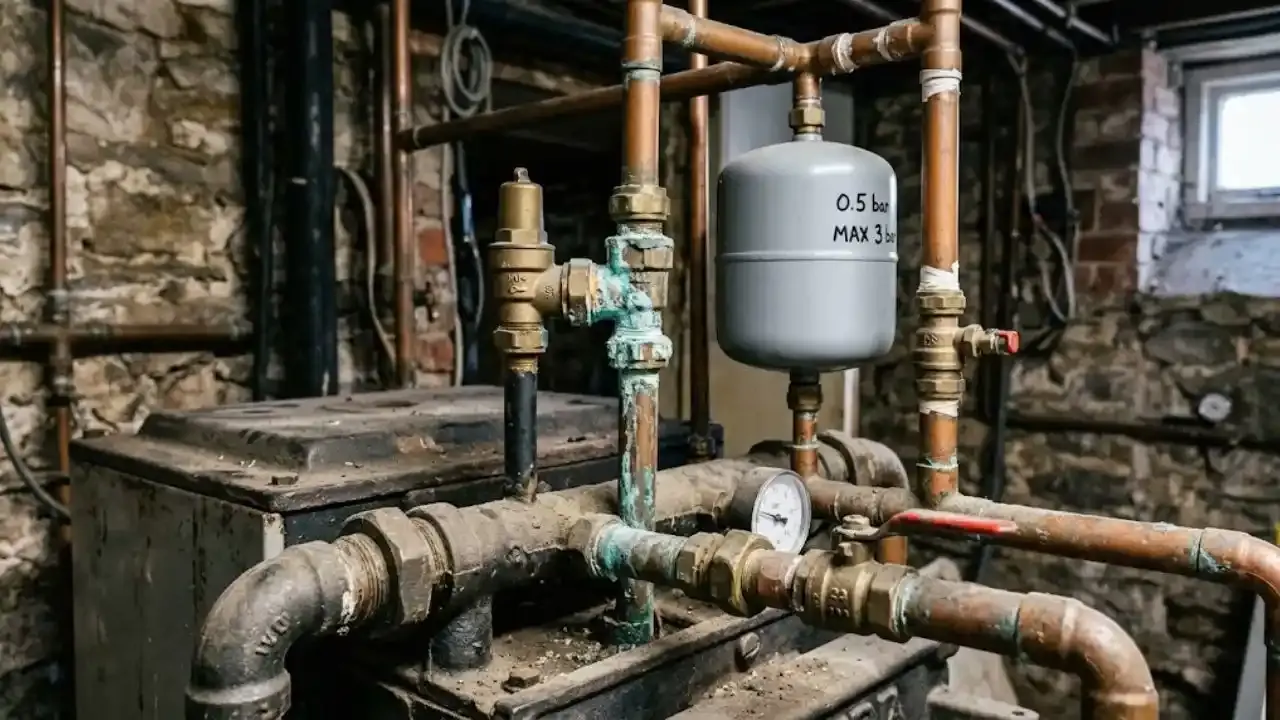
- The pressure relief valve and the expansion tank.
- Anything that needs a new part cut into the supply or return piping.
How to bleed a radiator without making things worse
Start with the radiator farthest from the boiler. Hold a cup under the bleed valve, open it a quarter turn with a radiator key, and wait for the hiss to stop and a thin stream of water to appear. Close the valve firmly.
Check the pressure gauge afterward. Bleeding drops system pressure, and a boiler with low pressure will not fire. If the gauge now sits below 10 psi, stop and call so the fill valve is handled correctly.
Planned service beats a midnight breakdown
An annual tune-up covers the same checks a technician would perform in an emergency, but with the heat still on. Combustion testing, a clean heat exchanger and a clear flue cost less in time than a no-heat night in January.
If your boiler is old enough that parts are hard to find, ask a licensed plumber about replacement options while it still works. That conversation is calmer in October than it is in a cold snap.
Westborough, MA note: licensing and the state fuel gas code
Plumbing and gas fitting in Massachusetts are regulated by the Board of State Examiners of Plumbers and Gas Fitters. Its license types include journeyman, master and apprentice registration. Homeowners can use the state's Check a license tool on mass.gov to confirm a contractor before work starts.
Gas work follows 248 CMR 4.00, the Massachusetts fuel gas code, with amendments to NFPA 54 in 248 CMR 5.00. The practical result: gas connections at your boiler are not a DIY job, and the person who does them should be able to show a current license.
For permits tied to a boiler replacement, permit rules vary, so ask the Westborough Building Department at 34 West Main Street. Westborough sits west of Boston along I-90 and I-495, so winter cold-snap calls cluster when the whole MetroWest area wakes up to cold radiators at once.
Run the green zone checks and then decide honestly which zone you are in. If the answer is red, boiler repair dispatch is available around the clock for Westborough, and the same dispatch reaches Shrewsbury and Hopkinton. If you are planning ahead for a replacement, a conversation about plumbing installation work can cover the piping changes before the cold snap arrives.
Boiler repair: questions answered
No. Press it once. If the boiler fires and stops again, repeated resets can load the combustion chamber with unburned fuel. A second failure means something is wrong with the flame sensor, venting or fuel supply, and a licensed pro should look at it.
Turn the boiler off at the service switch and look for visible leaks at the relief valve, the radiators and the supply pipes. Do not add cold water to a hot boiler. Call for service so the leak and the fill valve are both checked.
Once a year, ideally in early fall before the heating season. The visit covers combustion testing, safety controls and a cleaned burner, which are the checks a mid-winter emergency call would do anyway.
A gentle tick as the pipes heat is normal. Sharp banging or a constant gurgle can mean trapped air or scale in the boiler and should be checked, especially if it comes with low pressure.
Use the state's Check a license tool on mass.gov, which covers the Board of State Examiners of Plumbers and Gas Fitters. Ask for the technician's license before any gas connection is touched, and keep the permit paperwork for your records.
Want a licensed plumber to look at it? Call (508) 389-4045
Plumbing problem in Westborough?
Call dispatch any hour and get a clear price before work starts.