What a water jet does that a cable cannot
A cable is a spinning blade on a coil. It cuts a channel through a blockage, and the channel is often only an inch or two wide. The rest of the buildup stays on the pipe wall and traps the next load of debris.
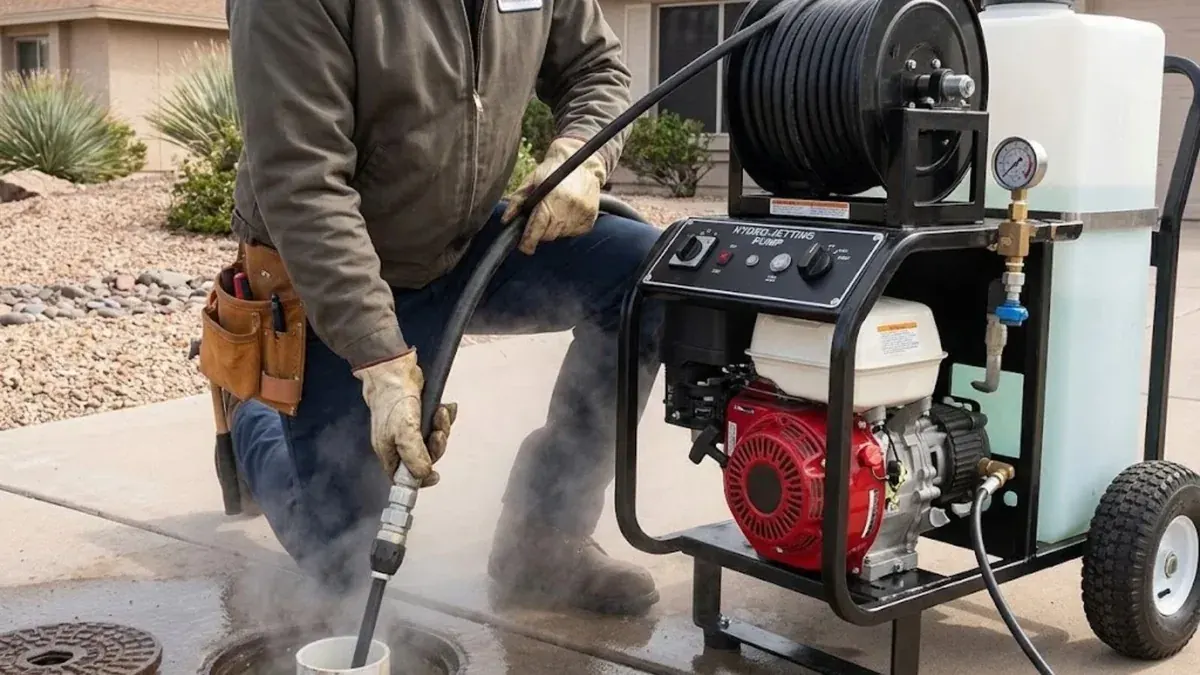
A jet nozzle sends water backward and sideways at high pressure while it is pulled up the line. The water scours the entire circumference of the pipe and flushes the debris toward the cleanout or the main. The pipe ends up near its original diameter, which is why the clog takes much longer to return.
Water volume matters as much as pressure. A jetter that moves a large flow of water carries debris out of the line instead of pushing it into a bend.
We snaked it and it got stuck: what that usually means
A cable that jams at a fixed distance, say 60 feet, usually hit something that does not give. Common causes are a root mass, a heavy grease cap or a collapsed section of pipe. The cable fails to pass because it is turning in place.
That is the point at which a camera should go in. If the pipe is intact, a jet with a root-cutting nozzle can usually pass the obstruction. If the camera shows a broken or offset pipe, jetting would only push water into the surrounding soil, and the job becomes sewer line repair instead.
Backup tonight: what to do before the jetter arrives
Hydro jetting is the right answer for many repeat backups, but the first priority is limiting damage while dispatch is on the way.
- Stop every water source in the house. Wastewater has nowhere to go and will keep rising at the lowest drain.
- Cover floor drains in the basement with a heavy lid or a weighted board if they are bubbling, and move stored items off the floor.
- Find the sewer cleanout, often a capped pipe near the foundation or in the basement. Tell the dispatcher where it is. Do not open it yourself, since a full line can discharge forcefully.
- Keep pets and children away from any standing water, and wash your hands after touching anything wet.
- Photograph the damage for your records and for any insurance conversation.
Camera first, then the jet: how the job is sequenced
A responsible jetting visit follows an order, and skipping the early steps is how pipes get damaged. The table shows what happens and why.
| Step | What happens | Why it matters |
|---|---|---|
| Locate the cleanout | Find the access point and confirm the pipe size | Sets the nozzle size and flow. |
| Camera inspection | Look at the pipe from the cleanout to the main | Shows breaks, offsets and root mass before pressure is applied. |
| Test pass with a small nozzle | Open a path through the worst of the blockage | Lets water drain so debris can be carried out. |
| Full jet pass | Pull the rotating nozzle back along the whole line | Scours grease, scale and root hairs from the wall. |
| Second camera pass | Confirm the wall is clean and note any damage | Gives you a record of the pipe condition. |
Roots, grease and scale: three coatings, three nozzles
Roots enter at joints looking for moisture. A jet with a cutting nozzle trims the fine roots flush with the pipe wall, but it does not stop the joint from leaking. Expect roots to return in a year or two unless the joint is repaired.
Grease forms a waxy ring that narrows the pipe a little each year. A flat-spray nozzle at moderate pressure strips it without gouging the pipe. Scale from hard mineral deposits is the toughest, and it may need several passes at different angles.
Which of the three you have can be seen on the camera. That is why a plumber who skips the camera is guessing at the nozzle.
Pipes that should not be jetted
High pressure is not safe in every pipe. A responsible plumber declines to jet when any of these apply, and tells you why.
- Cracked, broken or offset sections that the camera has already found, because water will blast into the soil.
- Thin-walled or heavily corroded cast iron, which can flake and release a plug of debris downstream.
- Old clay lines with loose joints that a jet may separate.
- Pipes that have been lined with a failed liner, where the pressure can strip the liner.
- Fixtures without a proper cleanout, where the access point is a toilet flange that cannot take the hose.
Restaurants and shops along the Route 9 corridor
Route 9 carries much of Westborough's commercial activity, and food service lines are heavy users of jetting. Kitchen drains discharge fats, oils and grease that build up in the shared lateral faster than in a house.
A scheduled jet every few months, set by what the camera shows, is cheaper than repeated emergency calls. Property managers can pair that schedule with commercial plumbing service visits for backflow and grease trap checks. For homes in nearby Shrewsbury the same equipment reaches the neighborhoods described on the Shrewsbury emergency plumbing page.
How often jetting makes sense
A house with a sound pipe and a one-time clog may never need a second jet. A home with mature trees close to the sewer lateral, or with a long run of old iron, may benefit from a jet every one to three years, depending on the camera.
Keep the camera recording. It lets you compare the pipe wall year over year and decide when a cleaning has stopped working and a repair is the better spend.
What affects the cost of hydro jetting
You hear a clear price before work starts. These are the usual drivers.
Homeowners coverage often excludes the cleaning of a gradual blockage but may cover resulting water damage. Ask your insurer whether drain or sewer backup coverage is on your policy before you file.
Describe what the line is doing and call for a price range before a truck is sent.
If your cable has already gone as far as it can, the next sensible step is a look inside the pipe. Call and ask for a camera first, then the jet if the line can take it.
Code and standards note. Jetting is a cleaning method, and any pipe repair that follows is regulated under 248 CMR 10.00. Ask for a camera view before and after the cleaning, so the standard you hold the work to is what the pipe actually looks like.
Hydro Jetting questions from Westborough homeowners
Yes. Dispatch answers 24/7. If the main line is backing up, a licensed plumber assesses it and uses a cable or a jet depending on the camera. If the pipe is damaged, you are told before any pressure is applied.
It depends on the pipe. Sound plastic or well-kept iron handles it. Cracked clay, thin cast iron and failed liners do not. That is why the camera runs first and the plumber explains the risk before jetting.
No. It trims roots flush with the wall, but they grow back into the same joint, usually within one to three years. Repairing or lining the joint is what stops them.
A snake cuts a channel through the blockage. A jet scours the full wall with a rotating water stream. For grease and scale the jet leaves a cleaner pipe, and for a simple hair clog the snake is faster.
Sometimes, if the obstruction is roots or grease. If the cable stops because the pipe is collapsed, a jet will not help and the camera will show it. Then a repair plan is the honest answer.
Usually yes. Fats and oils build up faster in kitchen laterals, so a schedule based on camera findings, often every few months, prevents the overnight backups that close a business.
Have a problem right now and want a plumber assigned? Call (508) 389-4045
Hydro Jetting in Westborough, any hour
Describe the problem to dispatch and you get a clear price before work starts.