
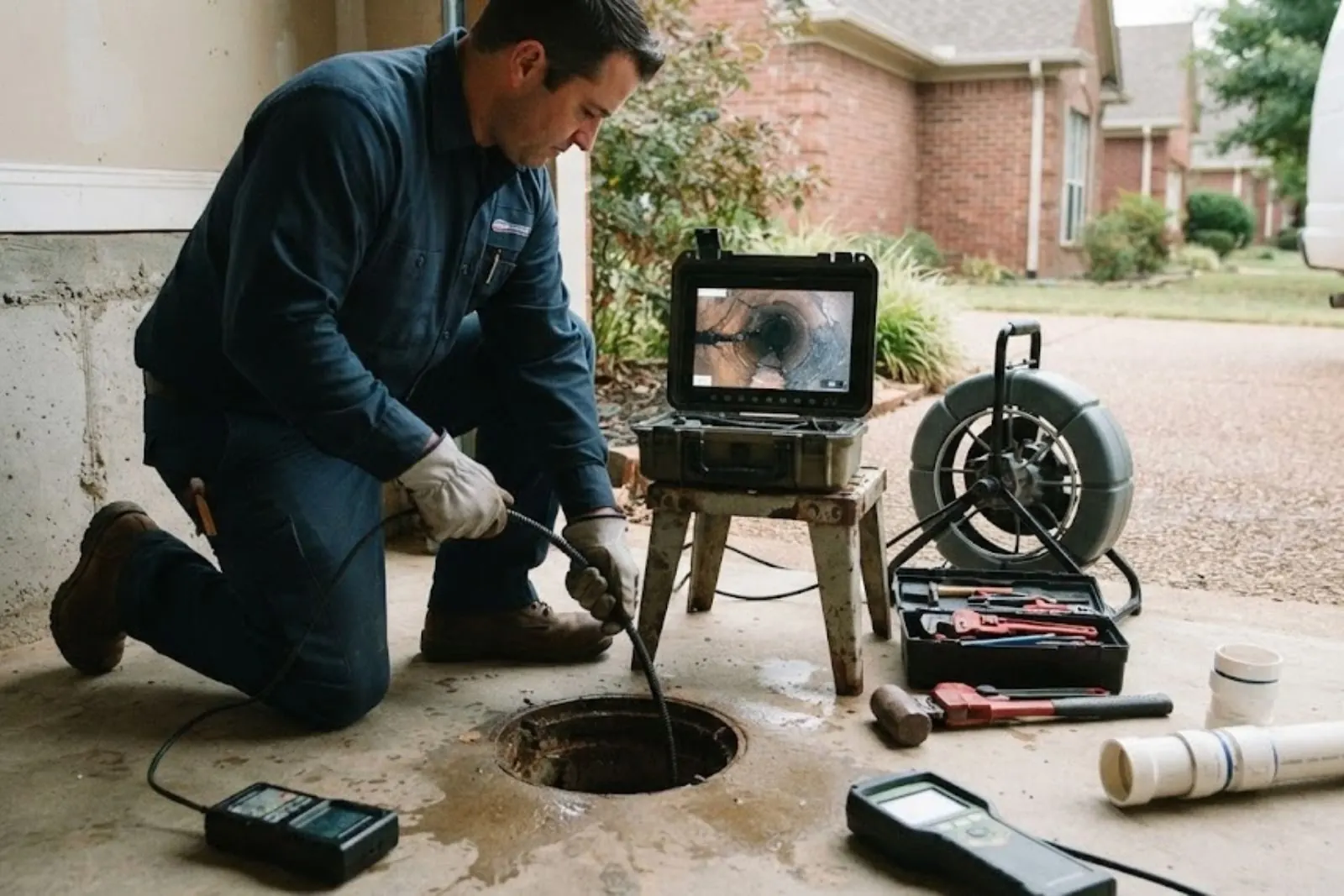
What the camera sees and what it cannot
The camera head rides on a flexible push cable with a light and a distance counter. It travels from a cleanout or a pulled toilet toward the street, showing pipe material, joints, roots, grease buildup, standing water and breaks.
The counter tells you how far down the line each fault sits. A locator can then mark that spot above ground, which saves digging in the wrong place.
The camera does not show what is behind the pipe wall, and it cannot pass a full blockage. A line that is flooded must be cleared first, which is why many inspections follow a drain cleaning visit.
Buying a house: what the report should answer
A home inspection rarely looks inside the sewer line. A camera report fills that gap, and these are the questions it should answer before you close.
- What is the pipe made of, and is it consistent from the house to the street or connection point?
- Are joints tight, or are there offsets, roots or cracks that will become repairs?
- Is there a belly, a low spot that holds water and waste?
- Is the cleanout in the right place, and does it open freely?
- How far from the house does each fault sit, and is it under paving, a tree or a garden?
Ten minutes inside a new pipe, an hour inside an old one
Hopkinton grew faster than any other community in Greater Boston between the 2010 and 2020 censuses, and Westborough has seen steady building too. Newer lines are mostly plastic and should show clean joints, but builders can leave debris and poorly seated joints inside.
A camera survey on a recent build can confirm the work before warranty periods end. Older lines take longer to inspect, since the plumber stops at each fault to record distance and condition. The Hopkinton emergency plumbing page explains how the same inspection is offered across the town line.
Reading the picture: findings and what they mean
Each thing the camera finds points to a different next step. The table shows the usual reading.
| What the camera shows | What it means | Usual next step |
|---|---|---|
| Fine roots at a joint | Early intrusion | Cut roots and watch, or seal the joint. |
| Grease or scale coating | Buildup reducing the bore | Cleaning or a jet pass. |
| Offset joint | Pipes no longer line up | Spot repair. |
| Sag or standing water | A belly in the pipe | Replace that section. |
| Cracked or broken pipe | Structural failure | Repair or replace. |
| Clear, smooth pipe | No action needed | File the recording for future reference. |
Old pipe in a town with mill-era streets
Westborough's shoe, boot and straw hat factories date to the 1800s, and the Vintonville Historic District and West Main Street Historic District reflect that era. Homes and former commercial buildings of that age may have iron or clay sewer pipe that was never replaced.
A camera survey is the cheapest way to learn that before you buy or renovate. If the footage shows iron with heavy corrosion, you can plan a replacement on your schedule instead of after a backup.
Using the recording after the visit
The recording is yours. Keep a copy with your closing documents or your home maintenance file. If you sell, a recent clean recording tells a buyer the line was checked.
If the footage shows damage, you can use it to compare quotes from other contractors, since all of them can see the same fault at the same distance. Pair it with sewer line repair planning when the findings call for it.
When an inspection is not enough
A camera is a diagnostic tool, not a repair. If the pipe is flooded, the inspection waits until the line is cleared. If the findings are borderline, the plumber may recommend a second look after cleaning.
Inspections also do not replace a septic system evaluation. If your home is on septic, ask who should assess the tank and the field, since that is typically a different specialist.
What affects the price of a camera inspection
You get a clear price before work starts, and these are the variables.
Insurance seldom pays for a planned inspection. If a covered event such as a sudden pipe failure caused damage, the footage can support a claim.
Ask for a price range when you call, and mention whether this is for a purchase.
A camera inspection costs a small share of what a surprise sewer replacement costs, and it turns a guess into a picture. Call to schedule one before you buy, renovate or repair.
Code and standards note. A camera inspection is diagnostic, and when a repair is needed the findings are described against 248 CMR 10.00. Ask for the recording and a written summary, so you can compare quotes on the same evidence.
Sewer Camera Inspection questions from Westborough homeowners
A typical single-family lateral takes under an hour once the camera is in. Old iron lines with many faults take longer, since each is measured and recorded.
Yes, ask for it when you book. A recording lets you compare quotes and gives a future buyer a record of the line's condition.
It can show active water entering through a crack or joint, and root growth that suggests one. Water leaving the pipe into soil is harder to see, so a plumber may add a dye or a smoke test.
If it is flowing, no. If it is flooded or heavily coated, it needs cleaning so the camera can see. The plumber can do both in one visit.
Usually not. Home inspectors look at visible plumbing. Ask for a separate sewer scope before you close on a house.
Yes. Commercial laterals are often larger and busier, and the same method applies. Mention the building use when you call so the right equipment comes.
Have a problem right now and want a plumber assigned? Call (508) 389-4045
Sewer Camera Inspection in Westborough, any hour
Describe the problem to dispatch and you get a clear price before work starts.