
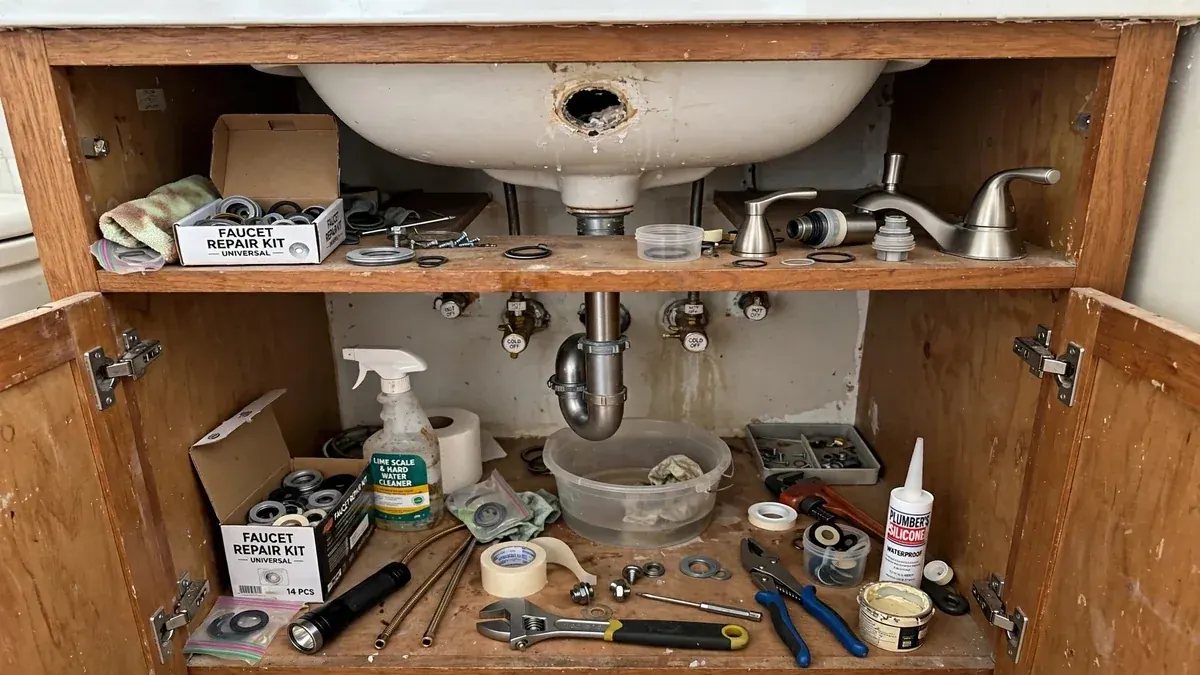
Follow the water: supply side first
Hot and cold water arrive through two small pipes that come out of the wall or floor. Each one ends at an angle stop, also called a shutoff valve. These valves let you cut water to the faucet without shutting off the whole house, and they are the first thing to find before you touch anything else.
From each stop, a braided flexible supply line runs up to the faucet shank. The braided stainless sleeve protects an inner rubber or plastic tube. Those inner tubes age, and a supply line that is eight to ten years old is a common source of a slow cabinet leak that ruins the floor of the cabinet before anyone notices.
If a stop valve will not turn, or it weeps around the handle stem, do not force it. A frozen stop that snaps can send water into the room. That situation is a job for faucet and fixture repair with the main valve already closed.
A parts map you can read in one minute
Use the table to match what you see under the sink with what the part does and what usually goes wrong with it.
| Part | What it does | What fails first | Who should fix it |
|---|---|---|---|
| Angle stop valve | Shuts off hot or cold to this fixture only | Stem seal weeps or the handle seizes | Plumber if it will not turn. |
| Braided supply line | Carries water from the stop to the faucet | Loose nut or aged inner tube | Capable homeowner. |
| Faucet cartridge or valve | Mixes and meters the water | Drip from the spout, stiff handle | Homeowner or plumber. |
| Sink strainer and basket | Seals the drain opening to the tailpiece | Putty or gasket leak under the bowl | Capable homeowner. |
| Tailpiece | Short vertical pipe under the strainer | Cracked thin plastic | Homeowner. |
| P-trap | Holds a water seal against sewer gas | Loose slip nuts, buildup, pinhole | Homeowner. |
| Trap arm and wall stub | Leads to the drain line in the wall | Slow flow from a partial clog | Plumber for clogs past the trap. |
| Vent in the wall | Lets air in so the trap does not siphon | Gurgling when the sink drains | Licensed plumber. |
The P-trap is doing more than catching rings
The curved section of drain pipe below the sink is the P-trap. It keeps a plug of water in the bend, and that plug blocks sewer gas from rising through the drain. If a sink goes unused for months, the water can evaporate and a faint sewer smell can appear. Running the tap for a minute usually fixes that.
A trap also collects grease, coffee grounds, and the occasional dropped spoon. Slip nuts connect it, and they hand-tighten with a quarter turn of a wrench at most. Over-tightening cracks the plastic washers. When a trap leaks, the cause is nearly always a nut that backed off or a washer that sits crooked, not a failed pipe.
If the water backs up past the trap, the clog sits deeper in the drain line. At that point a plastic snake bought at a hardware store can help with a soft clog, but repeated clogs call for professional drain cleaning so the line is cleared all the way to the main.
Disposal, dishwasher, and the high loop
Many kitchens add two more connections to the sink drain. A garbage disposal bolts to the strainer flange, and a dishwasher hose ties into either the disposal inlet or a spot on the tailpiece. The dishwasher hose should rise into a high loop under the counter before it drops to the drain connection. The loop keeps dirty sink water from running back into the dishwasher.
A disposal that hums but does not spin is usually jammed, not dead. A leak from the bottom seal or the flange is a different matter. Those leaks come from worn gaskets and rarely heal. Our garbage disposal repair page covers when a replacement is the sounder choice.
Signs a leak is hiding under your sink
Check these on a day when you can empty the cabinet and look with a flashlight.
- A musty smell in the cabinet that does not match the trash can.
- Swollen, peeling, or darkened particleboard on the cabinet floor.
- Water drops on the underside of the counter near the faucet base.
- A white crust on a supply nut, which is mineral left behind by a slow weep.
- Wet paper towel after you lay it flat under the trap overnight.
- A water meter that moves while every fixture in the house is off.
What a homeowner can do and what should wait
Replacing a braided supply line, a strainer basket, or a worn P-trap is reasonable work for someone comfortable with a wrench and a bucket. Close the angle stops first, open the faucet to relieve pressure, and keep a towel under every joint you open.
Anything that touches the wall, the vent, or a stop valve that will not close is different. The Massachusetts plumbing code is 248 CMR 10.00, and the state Board of State Examiners of Plumbers and Gas Fitters licenses the people who work under it. Permit rules vary, so ask the Westborough Building Department before you move or add any drain or vent piping.
Westborough, MA note: what the town water does to the parts under your sink
The Westborough Water Department draws from nine groundwater wells and the Westboro Reservoir, based on MassDEP's source water assessment. That report also names fluoride, chlorine disinfection, and corrosion control with potassium hydroxide and zinc orthophosphate. It is an older assessment, so read the current annual water quality report for today's treatment.
The practical point is simple. Whatever your hardness turns out to be, mineral crust at a supply nut or a spout aerator tells you the fitting is weeping or scaling. Test your tap, ask the water department for its annual report, and replace aerators and braided lines on a schedule instead of waiting for a stain.
A quick look under the sink twice a year is the cheapest plumbing insurance there is. If you find a wet spot you cannot trace, or you meet a valve that will not close, the nearby towns of Northborough and Southborough are on the same dispatch route as Westborough, so help is not far away.
Kitchen sink plumbing parts: questions answered
Run only the cold tap and watch the supply connections, then fill the sink and release the water while watching the trap. A drip that appears only when water runs through the drain points to the trap, strainer, or tailpiece. A drip that appears with the tap on points to the supply or the faucet base.
Gurgling means the drain is pulling air through the trap because the vent or the drain line is partly blocked. A single occurrence after a heavy load can be a soft clog. Repeated gurgling needs a plumber to check the vent and the line.
Both work. Plastic resists corrosion and is easy to replace. Chrome-plated brass is thicker and stands up better to being bumped by storage items, but it can corrode from drain cleaners. Match the trap size to the existing tailpiece.
Yes, if the angle stops work. Turn each handle clockwise a quarter to a full turn, then open the faucet to confirm the flow stops. If a stop leaks when turned, close the main valve and call for repair.
No. The parts under a sink are the same everywhere in Massachusetts. Northborough and Southborough both buy their water from the MWRA, while Westborough has its own wells and reservoir, so the mineral scaling you see on fixtures can differ even when the parts match.
Want a licensed plumber to look at it? Call (508) 389-4045
Plumbing problem in Westborough?
Call dispatch any hour and get a clear price before work starts.